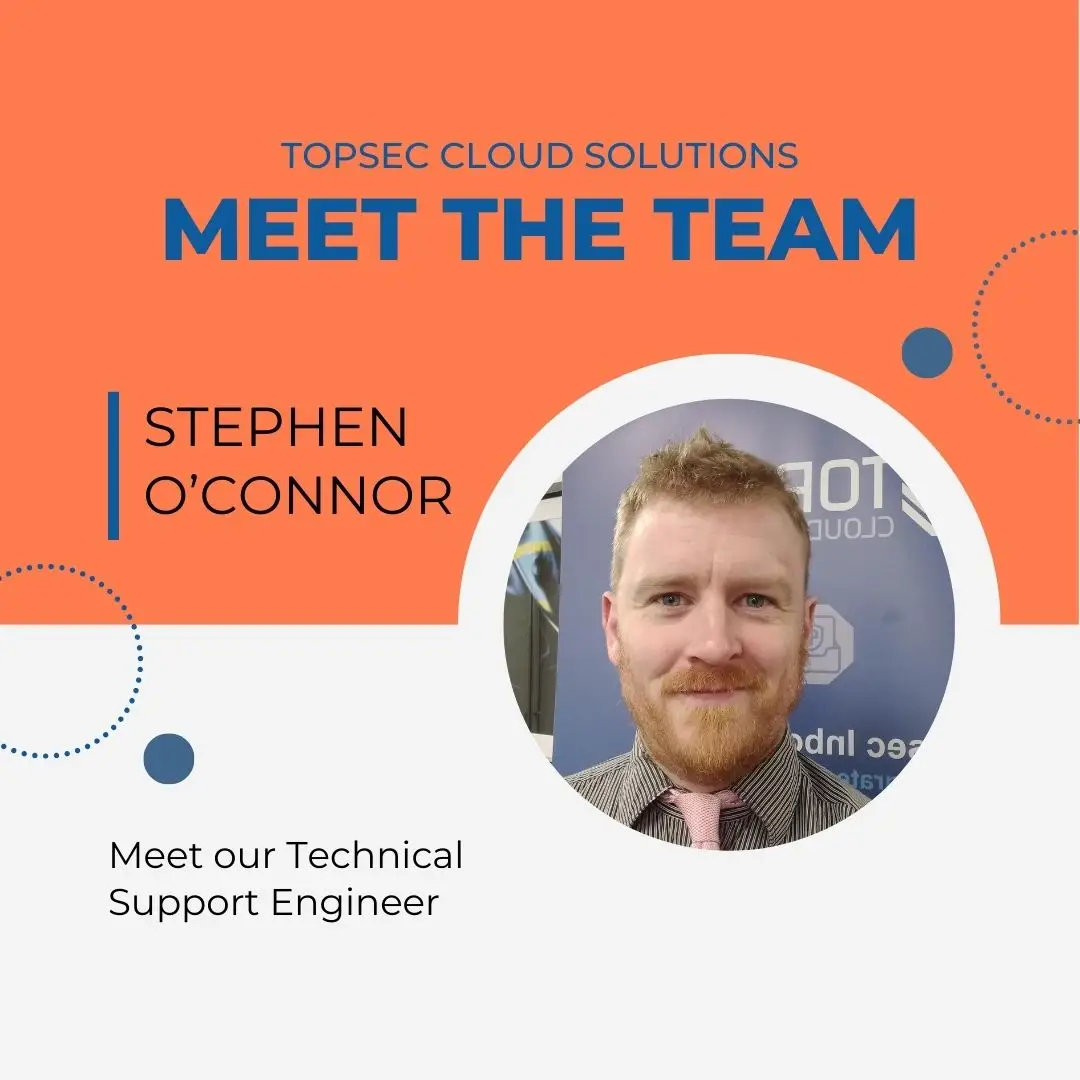
Meet the team: System Administrator, Daud Butt

Daud Butt is the IT System Administrator at Topsec Cloud Solutions. He’s made Ireland his home since 2016 and lives his value of putting the client first in his role. We recently chatted with him to get his take on email security.
The Evolution of Phishing Awareness Training

Phishing awareness training has evolved as hacking and phishing have grown in complexity.
Vishing (Voice Phishing): The Growing Threat and How to Protect Yourself

Learn about vishing, a type of voice phishing scam where fraudsters use phone calls to steal personal information. Discover how to protect yourself from vishing scams and stay informed with the latest cybersecurity tips to prevent fraud.
Meet the team: Digital Marketing Manager, Rianka Gupte

Topsec’s Senior IT Architect, Alan Buckley shows us why designing with flair is the best way to combine human and machine.
The Anatomy of a Phishing Email: How to Spot Red Flags and Stay Safe

To protect your organisation from ransomware and phishing attacks, it is important to know the anatomy of a phishing email. Read our blog to know more!
Meet the team: Senior I.T Architect, Alan Buckley

Topsec’s Senior IT Architect, Alan Buckley shows us why designing with flair is the best way to combine human and machine.
Email Security: A Priority for Small and Medium Enterprises

Email Security: A priority for Small and Medium Enterprises. Email security is a critical priority for businesses of all sizes Get a Quote Download Datasheet Email Security > Email Security: A Priority for Small and Medium Enterprises By Cian Fitzpatrick | 3rd June 2024 As a small-to-medium business, you might think you don’t need to be concerned with all this cybercrime stuff. Cybercriminals don’t care for small businesses. The takings are too small. This couldn’t be further from the truth. But oddly, it is a widely held misconception. There’s a certain logic here that cybercriminals would be well aware of: big businesses have big budgets, right? They can spend a fortune on protecting their digital assets. Conversely, smaller businesses have smaller budgets, and probably less digital assets to protect (we’re talking data, the new gold). The return might be smaller, but the fruit is hanging lower. While you might think that you’re a small fry and don’t really need security for your business, make no mistake, that someone out there thinks you’re fry enough. And cybercrime is a growing economy, it’s become an easy trade, with ready-made software solutions available on the Dark Web. The facts are not optimistic. Cybercrime is the number one threat when it comes to financial crime in Ireland, says the Compliance Institute, which surveyed 230 compliance professionals working in Irish financial services. Hacking, phishing, online scams and other forms of cybercrime have overtaken tax evasion and insider trading. And anybody who accesses the internet, is a target and possible victim. So while smaller businesses are squeezed for resources, they simply cannot afford to neglect this issue. According to a 2022 report by Grant Thornton, cybercrime was going to cost Ireland more than €10bn that year. That’s a lot of money leaking out of the economy. The same report showed that one in three SMEs fell victim to cybercrime between May ’21 and April ’22, with an average pay-out to fraudsters at €22 773 per incident. But 2023 figures say that nearly three in four businesses (not necessarily SMEs though) had been attacked in the 12 months prior. That same report says that Ireland had the highest median average number of attacks, Ireland is the country most likely to pay a ransom and that the number was four times higher than the previous year. There is a silver lining however: The single biggest attack in Ireland in 2023, cost €118,128, down from €5.2m in 2022. Silicon Republic has also said that according to Hiscox Business Insurance, Ireland has the highest rate of cyber-insurance ownership of all the countries surveyed, which included the UK, Belgium, France, Germany, Spain, the Netherlands and the US. The direct financial implications are obvious, but less obvious is the reputational and trust damage that results from these issues. As well as private data that is now “in the wild”. Protect Your SME with topsec cloud solutions Get A Quote Types of cybercrime that target SMEs: Ransomware, as the name suggests, kidnaps data until money is paid over, simplistically. This is malware that blocks access to a victim’s data by encrypting it, and a decryption key can be “bought”. Business Email Compromise, BEC, attacks specific employees that have access to company funds or sensitive data. This is often combined with impersonation, where a fraudster will pretend to be a senior staff member or client. They’ll request money or access to systems. Password attacks unsurprisingly, involve cybercriminals using a range of methods to learn credentials. One study in 2022 found that more than 80% of successful hacks are as a result of accessing user login details. Social engineering, phishing, brute force, are all methods of gaining the information that’ll get a criminal in, either providing access to sensitive systems and data, or even to money. SMEs are just as much at risk of social engineering attacks. A recent report from 2022 says that organisations with over 2000 employees are only slightly more of a target than their counterparts with less than 100 employees. The number of attacks on a larger enterprise is far more, but as a percentage, it remains more-or-less the same. The bigger issue is that the cost of a breach is generally far more devastating for a small company, than it is for a larger organisation. Cybersecurity Ventures says that 60% of small businesses will close their doors six months after a security breach. This is a huge threat to small businesses, with 43% of online attacks focused on SMEs currently. Of concern should be that SMEs are seemingly unprepared for an attack. A 2023 report found that almost 25% of SMEs had either been attacked or hadn’t realised they’d been attacked in the 12 months prior. 61% of SMEs didn’t have dedicated cybersecurity experts, 47% didn’t have an incident response plan and 27% didn’t have cyber-insurance coverage. What can you do? Every company is experiencing budget cuts right now. It’s tight, but a large part of being a secure company is phishing awareness. Employee training and instilling security consciousness into each and every staff member is key. Regular training on identifying a potential “phishy” email, or social engineering and impersonation attempts are crucial. Multifactor authentication is an account login process that demands more than one method of logging in. It may involve a password as well as a security token, or biometric verification. Software systems that prevent dodgy emails from even entering an organisation’s domain are a favourite preventative measure. If measures can be taken to halt the threat before it even reaches inboxes, that’s ideal. An incident response plan should also be in place. A cyber attack has become a likely event in today’s world, and planning for the eventuality may help limit the damage. It also generates a preventative-approach-mentality. Forewarned is forearmed. More and more, legislation is forcing companies – big and small – to take responsibility for their own environment and accountability for a breach. Organisations are only really holders of data, not owners. The onus is on these companies to
DMARC is now compulsory, thanks to Yahoo and Google.

DMARC is now compulsory, thanks to Google and Yahoo. Email Security requires DMARC Protection. Get a Quote Download Datasheet Email Security > DMARC DMARC is now compulsory, thanks to Google and Yahoo. By Cian Fitzpatrick | 17th May 2024 Not the cool kid in town, and as old as the internet itself, email remains the most productive business tool. By the same token, it’s the most effective tool for cybercriminals. With this in mind, regulators have been focusing on email security in an attempt to curtail cybercrime. As methods became more sophisticated than simply poorly worded emails promising royal riches from secret vaults in places unknown, so too have security protocols and technology to halt the incoming onslaught. Proactive security solutions are the only way to protect organisations in this age where data is gold. DMARC is now a compliance issue Domain-based Message Authentication, Reporting, and Conformance, also known as DMARC, is a solution developed to be highly effective in email security. So much so that Google and Yahoo have implemented stringent DMARC regulations taking effect in February of this year for senders of 5000 or more messages per day. Email domains must have a DMARC policy in the DNS (Domain Name System) and messages must pass DMARC alignment, or they won’t be delivered to Yahoo and Gmail inboxes. This applies to messages sent on an organisation’s behalf through email service providers such as MailChimp. The DNS is the equivalent of the internet’s phonebook – remember those? We access websites through a name, but web browsers talk to each other through IP addresses, so the DNS essentially converts domain names to IP addresses. What’s DMARC? DMARC integrates SPF (Sender Policy Framework) and DKIM (DomainKeys Identified Mail) to verify an email’s authenticity. One of the biggest issues in recent security breaches has been that attackers can impersonate a domain, making an email look like it comes from someone, when it really comes from someone else (a fraudster). DMARC is a robust solution that makes sure to check that the email originates where it says it originates, and can then block phishing and impersonation attempts. DMARC relies on two key elements: SPF confirms the origin of an incoming email. And DKIM, which uses encryption to authenticate an email and prevent identity forgery. DMARC records instruct recipient servers on handling emails that fail authentication checks, either by quarantine or outright rejection. This may be flagged due to a difference between a supposed email sender and the actual email address. It’s a crucial layer of defence. In the old days, platforms like Google relied on filters to sieve out spammers and fraudsters. The filters were often so severe that legitimate emails would be blocked. Cyber security is always a fine line between keeping a system safe and minimising user discomfort. Get DMARC Compliant with Topsec today Get A Quote More than just compliance, it’s about trust. Google and Yahoo’s move to compel businesses to adopt DMARC is encouraging. On one hand, organisations are teaching their employees to have a healthy distrust of email. However, as a brand and organisation, you want those with whom you engage to trust your digital communications. By implementing solid security measures like those offered by Topsec Cloud Solutions, it’s an opportunity to strategically raise your brand profile as one that can be trusted. The DMARC initiative by Google and Yahoo isn’t purely about technology. The three pillars behind this strategy from a user’s perspective are that email will be authenticated in the background (as discussed above), it will be easy to unsubscribe from mailing lists, and emails cannot be spammy – they have to be wanted by recipients. This is a positive move for users and organisations, although it does mean that businesses may have to review their technology strategy if they send more than 5000 emails a day. The idea is to encourage and enhance trust in email communications and to proactively protect against fraud. For organisations that have yet to implement DMARC, it’s an opportunity to ensure the protocol is correctly executed, but it’s also as a confidence-building practice within and across organisations. There’s an element of brand reputation and integrity in all of this. Who doesn’t want to do business with an ethical organisation that looks after its assets and its clients’ assets? For marketing teams, it’s a chance to demonstrate outstanding values and a security-aware ethos. This is not just a technology issue. Once again, it’s highlighted that cybersecurity belongs to each stakeholder in the business. There’s also the compliance angle. Failure to comply will lead to delays in email delivery and possible rejection. The effect on brand reputation and trust in integrity will be significant. And that’s the best-case scenario. The possibility of a cyber attack becomes very real for organisations that don’t comply, or which implement DMARC incorrectly. These attacks have devastating financial and reputational consequences. It’s the responsibility of each organisation to secure their digital channels. Recovering from a phishing or spoofing attack is expensive, time-consuming, and incredibly stressful for stakeholders. Data and privacy breaches become a nightmare for everyone and the damage can be permanent, or at best, lengthy to repair. DMARC in practice. Both Google and Yahoo offer transparent error codes for each email rejection. The error codes are freely available and offer an explanation along with the numerical code, making it easy to understand why an email was blocked, and what action should be taken. Failures are generally either temporary or permanent. With 90% of all cyber attacks initiated through phishing, which is generally done via email, it’s understandable that the largest tech organisations are taking control. By forcing companies to protect themselves and their users, they’re helping to make the internet a safer place and combat cybercrime. This is and always will be a process, but organisations need to work together. And this is more than a security issue, it’s a chance to prove to clients that your organisation is taking security seriously. Our DMARC Protection
Meet the team: Topsec CTO, Gavin Roberts

Meet The Team: Gavin Roberts Chief Technical Officer Send an Email Gavin Roberts Chief Technical Officer A lover of technology and a committed family man, Gavin Roberts has the work/life balance conundrum sussed with a focus on technology’s capabilities and regular (not as regular as he’d like though!) fishing trips. We recently enjoyed a friendly chat over coffee to delve deeper into Gavin’s world, both professionally and personally. Here’s what we discovered! Q. 1 Can you share key experiences that led to your role at Topsec Cloud Solutions and how they shape your approach? Gavin: Sure, I’ve had quite the journey in the tech field. I started in support roles with major companies like DEC and Compaq, which later merged into HP. This early experience laid the foundation for my tech career, emphasising the critical nature of robust support systems. Then I got an opportunity to move into the secure payments industry. This was a pivotal moment. It was the early days of online payments, and I was deeply involved in fraud prevention. This role gave me a thorough grounding in understanding the intricacies of security and technology. The next step for me was a natural progression to focus more on coding and security solutions. Which led me to the CTO role at Topsec. My approach has always been about blending robust technology with strong user support. I believe that technology should serve people. Not the other way around! “I believe that technology should serve people. Not the other way around!” Q. 2 Can you outline major shifts in email security and their impact on Topsec’s strategies and the industry? Gavin: Over the years, the landscape of email security has evolved significantly. The rise of AI and machine learning has been transformative, but we need to have a balanced approach. It takes time to separate the hype from the true functionality. At Topsec, we integrate AI cautiously to enhance our existing strategies while maintaining the human touch. This is crucial in crisis situations. We’ve also seen an increase in sophisticated threats like QR code phishing and tricky OneDrive URLs, which can change after passing security checks. To combat these, we’ve developed tools that re-scan links and attachments over time to catch these delayed threats. “This proactive approach keeps our clients safe and cements our place as an industry leader in innovation.” Q. 3 How do you ensure a human-centric tech approach amidst technical complexities, and can you share examples? Gavin: Technology is complex. But Topsec sets itself apart by investing the time to make it accessible and beneficial to our users. This isn’t lip service; we put our money where our mouth is. For example, we prioritise user-friendly interfaces and clear communication, so our clients understand what our technology is doing for them. A great example of our human-centric approach is our customer support. Our clients regularly comment on how reassuring it is to speak with a person when they encounter an email security issue. We have a dedicated team that not only addresses technical issues but also ensures our clients feel supported throughout their security journey. It’s about building trust and relationships, not just offering tech solutions. Q. 4 Highlight a significant success story during your tenure at Topsec that exceeded expectations. Gavin: One standout moment was the development of our “Inbox Protect” tool. It was initially designed to offer internal tenant protection but ended up solving several emerging loopholes involving dynamic links. This tool has been crucial in preventing new kinds of email-based attacks, protecting their email eco system both internally and externally. Q. 5 What emerging trends in email security excite you, and how is Topsec preparing for them? Gavin: The integration of AI in cybersecurity is particularly exciting. As mentioned, there’s a lot of hype around AI but some remarkable use cases are also emerging. “At Topsec, we’re focused on leveraging this technology to enhance our predictive capabilities and improve the user experience.” Sometimes speed is a good thing and sometimes not. At Topsec, we’re deliberately taking a gradual and informed, and even incremental approach, to ensure the adoption of AI ensures we remain at the cutting edge without compromising on security. Q. 6 Share strategies for maintaining work-life balance in a high-pressure tech environment. Gavin: Well, life is busy which makes the business case for taking breaks even stronger! I’m from Wales originally, and while I’m delighted Ireland has been home for many years already, it’s a great feeling to head back to see my family and friends too. I’m lucky to be able to do that fairly regularly with my friends. I also love fishing and a fishing trip is my ideal weekend away. And then I also sketch. I’ve drawn portraits for many years. In fact, I was once considering studying art. I’m glad technology won out but that I still draw. People occasionally ask me to draw portraits for them, perhaps of their children or grandchildren to give as a gift. So I still get plenty of opportunities to get my sketch pad out! Q. 7 How does customer feedback influence product development and service strategies at Topsec? Gavin: Customer feedback is integral to our development process. It helps us understand user needs and guides our product enhancements. For instance, feedback on our email security tools has led to improvements that make them more intuitive and effective. Feedback is how we evolve in alignment with our customers’ needs. Q. 8 Describe your leadership style and its impact on your team’s dynamics and performance. Gavin: The broader culture at Topsec is all about taking ownership and this filters into my leadership of my team. It’s important to convey to team members that they are part of a team. We’re here to support each other, and as CTO I am determined to give my team members everything they need to succeed. However, at the same time I create an environment where my staff feel empowered to take initiative and own their projects. We
How to Build a Resilient Email Security Architecture

How to Build a Resilient Email Architecture. Strategies for Enhanced Cybersecurity Get a Quote Download Datasheet Email Security > How to Build a Resilient Email Architecture. By Cian Fitzpatrick | 1st May 2024 Email (and email security) is the cornerstone of modern business. Efficient, convenient, productive, it’s the most prolific business tool on which we’ve come to rely. Hence, email remains the primary medium by which cyber threats enter an organisation (91% of threats come through this gateway). Tactics to slide through security systems are becoming increasingly sophisticated, and reliance on human fallibility is key to successful breaches. Effective cybercriminals use a multipronged approach in their endeavours: technology… and social engineering. If we wish to counteract their techniques, we need to proactively defend our assets. And also use a multidimensional strategy. Technology alone is not enough. But it helps. Employee education alone is not enough. But it helps. What are the biggest threats to email security? Bad actors are getting smarter. We’re seeing more malicious QR codes within emails and email attachments. They often appear harmless at first, but post-delivery, they’re able to change destination or characteristic. Likewise with URLs, threats can be triggered and clicks redirected, hours or even days after arrival in an inbox. This can make it difficult for gateway security systems to nab threats as they enter a domain. There’s also been a rise in OneDrive as a delivery method of malicious threats, with files that look initially like they contain nothing untoward. Again, threats are triggered some time later. Whaling and spear phishing attacks are on the increase, where senior staff is tracked and targeted. Information is accumulated from across the web, using social media, and professional platforms to find out who’s-who and where they are. Impersonation techniques involve the clever use of AI and other easily available technology. Remember that this is an industry the size of a country’s economy (third after the US and China, in fact). Compromises in the supply chain are also growing. The use of contractors can be risky. But who doesn’t use contractors and partners? If a supplier’s security is not up to scratch, the knock-on can be huge, and cybercriminals are exploiting smaller suppliers to funnel into larger organisations. Partners are often trusted and the relationship is solid, and so systems don’t flag them up. Human behaviour will always be a stumbling block for organisations. And not just users who are prone to social engineering – which is all of us – there’s also the risk that protocols like DKIM/DMARC are not set up correctly. Compliance regulations and cyber insurance policies may demand these protocols, but correct set-up takes effort and understanding. IT departments are under huge pressure, it’s not surprising then that these protocols become a mere box-ticking exercise. IT staff are often at the point of burn-out and their familiarity with risks, or incessant flags on the systems they monitor, can hinder them from seeing the wood for the trees. What can we do? Central to protecting a cyber environment is a proactive approach. Constant staff-awareness training should be one arm of defence, and technology, the other. A proactive approach means tackling emails before they reach inboxes, before they’re in transit on an organisation’s infrastructure. Once a threat is in an inbox, it could be too late. The onus is then on the user to determine that the email is fraudulent, and this could be the weak link. The sophistication of these scams lies in their appearing sound of character, links and attachments are unthreatening. But they’re manipulable once they’ve reached their destination, and that when they attack. Scammers are taking less of a birdshot approach now. They’re targeting specific people or roles in an organisation, and starting a process of engagement which begins innocently enough. Like this, their emails seem legitimate and go unflagged. Once they have you on a trusting journey, they’re able to lead you to malicious content. DMARC (Domain-based Message Authentication, Reporting and Conformance) is an email authentication protocol. Its aim is to protect an email domain from unauthorised use, particularly email spoofing, or the creation of forged email addresses. Set up DMARC Protection correctly in order to protect businesses from email-based compromises, phishing scams, and other cyber threat activities. Ensure your email security solution scans malicious qr codes Get A Quote The path of an email in an ideal environment On entry to an organisation, an email encounters an antivirus scanner, where it will be reviewed for legitimacy. DMARC and DKIM protocols will be correctly configured and vulnerabilities are constantly monitored on the Dark Web. The AV scanner will look at whether an email’s credentials have been previously encountered, if there’s an existing fingerprint for it, whether or not it has an attachment, link, or QR code. There are three options at this point. The email may be found to be legitimate and risk-free, it may be deemed malicious and blocked, or it may go into a sandbox for further investigation. There are several sandbox environments, one for attachments, one for URLs, one for QR codes. What’s a sandbox? An email sandbox is an isolated environment identical to the user environment. It’s like a laboratory, where an attachment can be exploded or code can be executed in the vacuum of the sandbox without affecting or bringing down the entire network. Sandboxes are particularly effective against Advanced Persistent Threats (APTs), which are custom-developed, targeted attacks. Their aim is to steal data and they’re designed to elude traditional detection methods. Human intervention and observation allows for further research into an attempted attack and action taken. The knowledge and experience of people cannot be underestimated in cybersecurity. Architecture aside… You can have all the best systems in place, solid procedures, cutting edge technology, and the most vigilant IT team, but ultimately, the target for cybercriminals is you and me. Every person in an organisation is a possible access point for a scammer. And so it is up to each person to be the